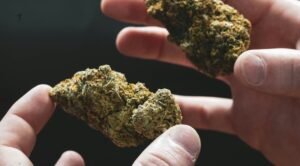
Short answer: live resin is a cannabis extract made from plants that were flash-frozen immediately after harvest instead of being dried and cured. Freezing preserves the volatile terpenes that normally evaporate during drying, so the finished extract tastes far closer to the living plant.
The Problem Live Resin Solves
Terpenes are what make one strain smell like citrus and another like diesel. They are also highly volatile — they evaporate readily at room temperature, and conventional processing gives them weeks to do exactly that.
Standard extraction begins with dried, cured flower. That drying and curing takes one to three weeks, and a substantial share of the lighter aromatic compounds is gone by the end of it. Whatever remains often gets stripped further during refinement.
Live resin removes that window entirely.
How Live Resin Is Made
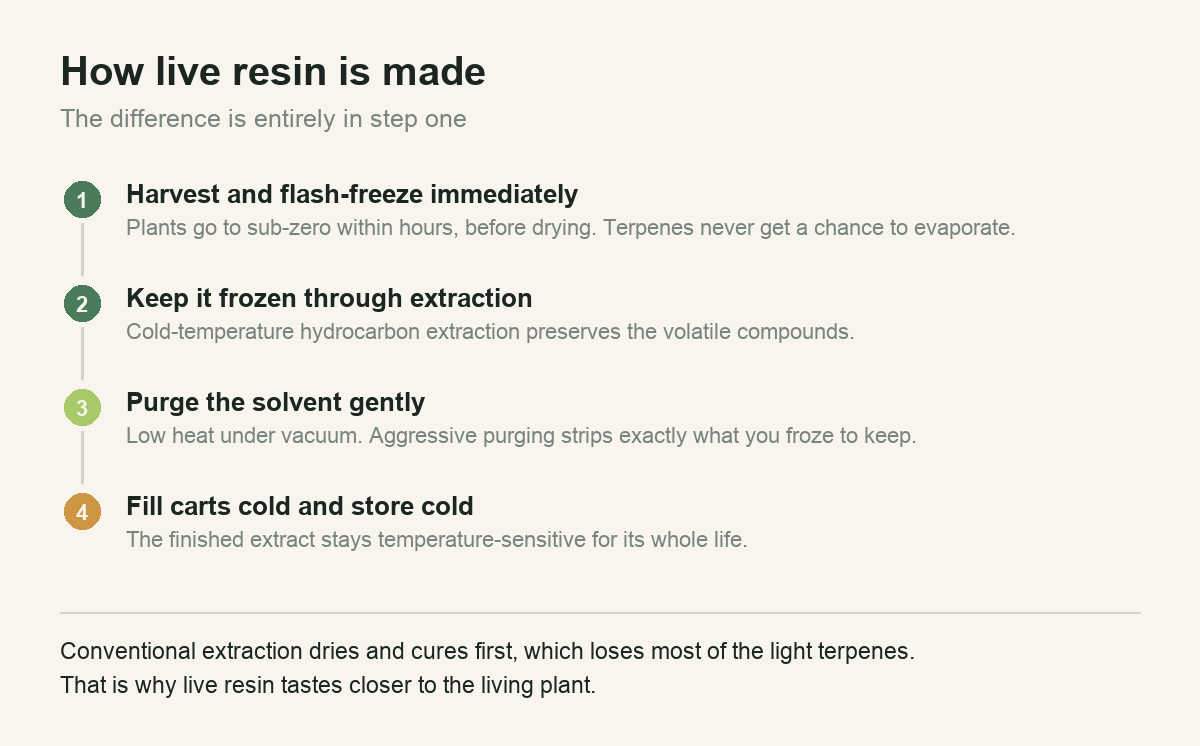
The plant goes from harvest to sub-zero within hours, and stays frozen through extraction. Cold-temperature hydrocarbon extraction then pulls the cannabinoids and terpenes together, and a gentle low-heat vacuum purge removes the solvent without cooking off what the freezing preserved.
Every stage is about not letting the material warm up. That cold chain is why live resin costs more: it needs freezer capacity, faster handling and tighter process control, and yields are lower.
What It Is Not
Two points of confusion worth clearing up.
Live resin is not live rosin. Rosin is solventless, made with heat and pressure from ice-water hash. Live resin uses a hydrocarbon solvent that is then purged. Both start from fresh-frozen material; the extraction methods differ completely, and rosin usually costs more.
Live resin is not automatically stronger. It usually tests lower for THC than distillate, because it has not been refined to isolate cannabinoids. What it has instead is terpene content.
What It Is Like to Use
The flavor difference is immediate and it is the reason people pay for it. Strain character comes through in a way distillate cannot reproduce with added terpenes.
Many people also describe the effect as fuller or more rounded, and attribute this to the entourage effect — the idea that cannabinoids and terpenes act together rather than independently. It is a plausible and widely held view, though the evidence base is still thin. Take it as a common subjective report rather than settled science.
Storing Live Resin
Everything that makes live resin good also makes it fragile. The terpenes preserved by freezing remain volatile in the finished product, so heat and light degrade it faster than distillate.
- Cool. Below room temperature is better. Some people refrigerate live resin concentrates, though carts are best simply kept somewhere cool rather than cold.
- Dark. UV breaks down cannabinoids — see how light degrades THC.
- Airtight and upright for cartridges.
- Use it sooner. Six to twelve months rather than the twelve to eighteen you would get from distillate.
For concentrate formats rather than carts, see how to store concentrates.
Is It Worth the Extra?
If you care about flavor, yes, clearly. If you are optimizing for THC per dollar, no — distillate delivers more milligrams for less money.
The comparison is laid out fully in live resin vs distillate carts.
Frequently Asked Questions
What does live resin mean?
Extract made from flash-frozen fresh cannabis rather than dried and cured material, which preserves the plant’s original terpenes.
Is live resin stronger than regular carts?
Usually lower in THC than distillate, but richer in terpenes. Many people find the effect fuller despite the lower number.
Live resin vs live rosin — what is the difference?
Both start fresh-frozen. Live resin uses a hydrocarbon solvent; live rosin is solventless, made with heat and pressure. Rosin costs more.
Does live resin need refrigerating?
Concentrates benefit from cold storage. Cartridges are better kept somewhere cool and dark rather than refrigerated, since cold thickens oil and causes clogs.