Short answer: store weed in an airtight glass jar, kept dark, at 60–62% relative humidity and below 70°F. Get those four things right and flower stays potent and flavorful for six months to a year. Get them wrong and you can lose a third of the THC in a matter of weeks.
That is the whole method in one sentence. The rest of this guide explains why each number matters, what actually goes wrong when you ignore them, and how the rules change for pre-rolls, edibles, carts, concentrates and seeds.
What Actually Ruins Weed
Cannabis does not simply “go stale.” Four specific forces degrade it, and almost every storage mistake is a failure to control one of them.
1. Light
UV exposure is the single fastest way to destroy potency. Light breaks THC down into CBN, a far less psychoactive compound, which is why old weed can feel sedating rather than strong. A clear jar on a sunny windowsill will do more damage in two weeks than a dark cupboard does in six months. This is the one variable where there is no acceptable middle ground: your storage needs to be genuinely dark.
Full detail: how light degrades THC and how to block UV.
2. Air
Oxygen drives the same oxidation reaction, just more slowly. Every time you open a jar you swap the saturated air inside for fresh oxygen, which is why a jar opened five times a day ages faster than one opened twice a week. It is also the argument for storing in several small jars rather than one large one: you only expose the portion you are actually using.
3. Heat
Heat accelerates every other reaction and evaporates the terpenes that carry flavor and aroma. Above roughly 70°F degradation speeds up noticeably; between 77°F and 86°F you enter the range where mold and mildew become genuinely likely if there is any moisture present. A cupboard above the stove or a car glovebox in August is the worst place in your home.
Full detail: storing weed through summer heat.
4. Humidity
Humidity is the variable people get wrong in both directions. Too dry and the trichomes turn brittle and shatter off the bud, taking potency with them and leaving a harsh smoke. Too damp and you are cultivating mold. The target is a narrow band, and hitting it is the difference between weed that smokes well at month six and weed you throw away.
The Numbers That Matter
These are the only figures you actually need to remember.
| Variable | Target | What goes wrong outside it |
|---|---|---|
| Relative humidity | 59–63% RH | Below 55%: brittle, harsh, trichome loss. Above 65%: mold risk. |
| Temperature | Below 70°F / 21°C | Faster THC loss, terpene evaporation, mold above 77°F. |
| Light | Complete darkness | UV converts THC to CBN. The fastest single cause of potency loss. |
| Air | Airtight, minimal headspace | Oxidation. Large half-empty jars age faster than full small ones. |
If you want the reasoning behind these ranges rather than just the numbers, see ideal temperature and humidity for cannabis storage.
The Best Container for Storing Weed
Glass, airtight, opaque or kept in the dark. That is the answer, and it has been the answer for a long time.
Why Glass Mason Jars Win
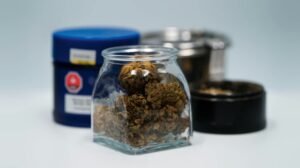
Glass is inert, so it does not leach anything into your flower or absorb terpenes the way plastic does. A proper two-piece canning lid gives a genuine airtight seal. They are cheap, reusable, and they hold humidity stable once conditioned. The only weakness is that clear glass does nothing to stop light, which is solved by storing the jar inside a cupboard, a tin, or a stash box.
What to Avoid
- Plastic bags. Not airtight, and the static charge actively pulls trichomes off the bud and onto the bag wall. The single worst common option.
- Thin plastic containers. Semi-permeable to oxygen, and they absorb terpenes over time.
- The original dispensary pop-top. Fine for a week, not designed for months. Most are not truly airtight.
- Wooden boxes on their own. Wood breathes and can impart flavor. Fine as an outer container around a glass jar, not as the seal itself.
- Grinder storage. Ground weed has enormously more surface area and degrades several times faster. Grind what you are about to use, not more.
Full comparison: mason jar vs airtight vs mylar. For lockable and smell-controlled options, see stash boxes and storage kits.
Controlling Humidity
A sealed jar holds whatever humidity was in it when you closed it. If your flower was slightly over-dried on purchase, a jar simply preserves that state. Two-way humidity packs solve this by both releasing and absorbing moisture to hold a set point.
The choice is essentially between 62% and 58% packs. Use 62% for general storage of properly cured flower — it sits in the middle of the ideal band. Use 58% if you prefer a drier smoke, live somewhere humid, or are storing material that was on the damp side.
Two practical warnings. A pack can only work in a sealed container, so there is no point adding one to a plastic bag. And a pack that has gone hard and crusty is spent — it has given up its moisture and is now doing nothing.
See how to use humidity packs and which percentage to buy, and Integra Boost vs Boveda compared.
Three Methods That Sound Clever and Are Not
The Fridge
The fridge is a humidity rollercoaster. Every time the door opens, warm room air meets cold jar and condensation forms. Fluctuating moisture against organic material is precisely the condition mold wants. A cupboard at stable room temperature beats a fridge almost every time.
The Freezer
Freezing does slow degradation, and it is genuinely used for long-term preservation. The catch is that frozen trichomes become glass-brittle, and the smallest handling knocks them off the bud. If you freeze, freeze in a fully sealed container, do not open it while cold, and let it return to room temperature completely before handling. For most people storing a normal amount, it is not worth the risk.
Both covered in detail: weed in the fridge or freezer.
Vacuum Sealing
Removing oxygen sounds ideal, and for genuinely long-term storage it has a place. But the vacuum crushes the flower and strips trichomes under pressure, and it does nothing about humidity — whatever moisture was in there stays in there, sealed against the bud. Useful for a harvest you will not touch for a year, wrong for your everyday jar.
Detail: does vacuum sealing weed actually work.
How Long Does Weed Actually Last?
Properly cured flower, stored correctly, holds good quality for six months to a year. It remains usable for up to two years, with steadily declining potency and flavor. Stored badly — a clear bag on a warm shelf — noticeable degradation starts within weeks.
Weed does not become dangerous with age. It becomes weaker and more sedating as THC converts to CBN. The genuine risk is mold, and that is a humidity failure rather than a time one. Any musty smell, grey or white fuzz distinct from trichomes, or a spongy texture means throw it away.
Full breakdown by product type: how long cannabis stays fresh.
Storage by Product Type
The four principles hold throughout, but the priorities shift depending on what you are storing.
Flower
The standard case: airtight glass, dark, 62% pack, cool cupboard. Keep buds whole until use. Full flower storage guide.
Pre-Rolls
The most fragile format, because a thin paper cylinder with a large surface area dries out fast. Store in an airtight tube or jar with a humidity pack. A dried-out pre-roll burns hot, fast and harsh. Pre-roll storage.
Edibles
Here you are managing food spoilage as well as cannabinoid degradation. Chocolate needs cool and dry to avoid blooming; gummies need airtight to avoid going hard; anything baked follows normal food rules. Keep everything clearly labeled and away from children. Edible storage.
Vape Cartridges
Store upright, always. A cart on its side lets oil creep into the airway, which is where clogging and leaking come from. Keep them out of heat and away from light; oil darkening is oxidation. Cartridge storage.
Concentrates
Wax, shatter, rosin and live resin each behave differently. Broadly: cooler than flower, silicone or glass rather than paper, and minimal air. Live resin is the most temperature-sensitive of the group. Concentrate storage.
Seeds
Completely different requirements — seeds are living material, not a consumable. Cool, dark, dry and stable, with the fridge genuinely appropriate here. Seed storage.
Long-Term and Bulk Storage
Storing a large quantity changes the approach in one important way: divide it. Keep a small working jar for daily use and seal the rest in separate containers you do not open. A single large jar opened daily exposes the entire supply to oxygen every time.
For genuinely long horizons, mylar bags with humidity packs, kept cool and dark, outperform glass because they exclude light completely and take up less space.
See storing a six-month supply and storing large amounts at home legally.
Smell Control
A properly airtight glass jar already contains odor almost entirely — if you can smell your stash through the container, it is not airtight, and that means it is not preserving your weed either. Smell escaping and potency escaping are the same failure.
For additional discretion, a lockable stash box with carbon lining adds a second barrier and keeps everything out of reach of children and guests, which matters legally as well as practically.
Traveling With Weed
The storage problem on the road is heat and vibration. A car interior can exceed 120°F in summer, which will degrade flower quickly and can leak a cartridge. Keep cannabis in the cabin rather than the trunk where possible, out of direct sun, in a sealed opaque container.
The legal constraints matter more than the storage ones. See traveling with cannabis in California and transport laws for your car.
The Mistakes Almost Everyone Makes
- Storing in the bag it came in. Convenient, and it is costing you potency every day.
- A clear jar in daylight. Glass is right, the location is not.
- Grinding in advance. Multiplies surface area and accelerates everything.
- Opening the jar constantly. Use small jars and leave the bulk sealed.
- Skipping humidity control. The most common cause of harsh, brittle, disappointing flower.
- Trusting the fridge. Condensation cycling is worse than a stable shelf.
- Storing near heat. Above the stove, near a radiator, on top of a games console.
Full list with fixes: the biggest storage mistakes.
Frequently Asked Questions
What is the best way to store weed long term?
Airtight glass or mylar, a 62% humidity pack, complete darkness, and a stable temperature below 70°F. Divide large quantities into separate sealed containers and keep one small working jar so the bulk is never exposed.
Does weed go bad?
It loses potency and flavor rather than spoiling. THC gradually converts to CBN, which is why older weed feels more sedating. The exception is mold, which is a genuine health risk and comes from excess humidity, not age.
How do you keep weed fresh?
Control the four variables: airtight container, darkness, cool temperature, and 59–63% relative humidity. A humidity pack in a sealed glass jar covers most of it.
Can you store weed in a plastic bag?
You can, but it is the worst common option. Bags are not airtight and static pulls trichomes off the bud onto the plastic. Even a cheap glass jar is a significant upgrade.
Should weed be stored in the fridge?
Generally no. Opening the door creates condensation inside the container, and fluctuating moisture is what causes mold. A cool, dark cupboard is better.
How full should a storage jar be?
As full as practical. Empty headspace is oxygen sitting against your flower. Use a jar size that roughly matches the amount you are storing.